
Light
By
Leonard Zwelling
https://www.nytimes.com/2014/04/22/science/mind-control-in-a-flash-of-light.html
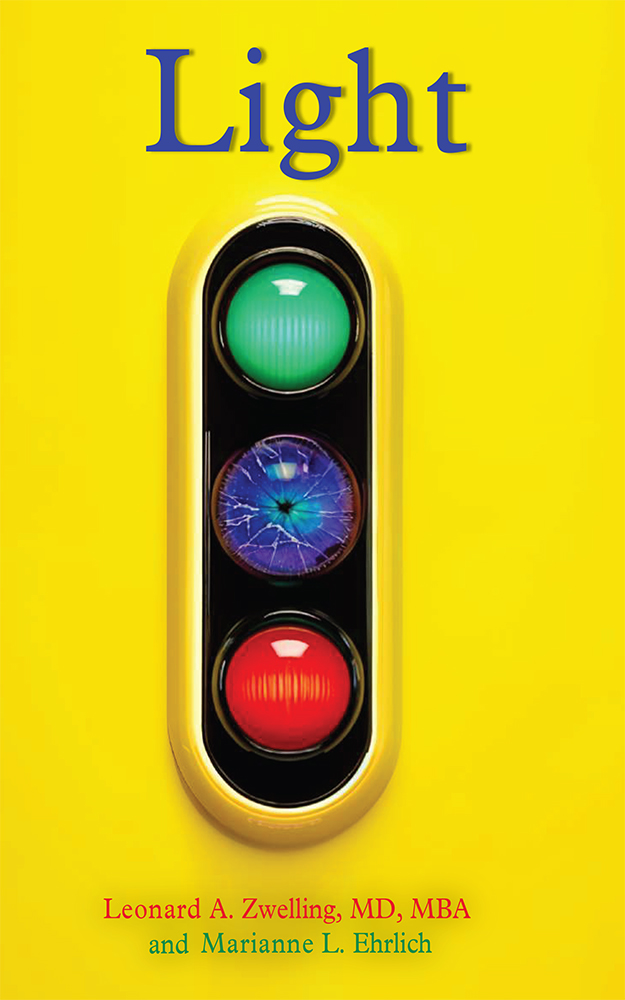
If you have visited my web site (lenzwelling.com) any time in the past six months, you would have seen the yellow cover of my new book called Light, co-written with Marianne L. Ehrlich. Well, it’s actually been published and available now on Amazon or through my web site or by using the direct link to Amazon above.
Here’s the two stories behind Light, the true one, and the one I made up.
It goes back many years to my days in the laboratory at MD Anderson and a very talented and brilliant high school student who worked in my lab one summer.
His father was the Chief of Hematology at the time and a friend of mine. He asked if I had room in my lab for his son Karl who was a high school student. Karl was probably about 16 or 17.
On Karl’s first day, he came into the lab with a very polite, soft-spoken, and reserved demeanor. To me, he sounded a bit like Sylvester Stallone, so I dubbed Karl, Rocky.
We sat in my tiny office and I explained what we do in the lab and our studies of drugs that act upon enzymes in the cell that alter the three-dimensional structure of DNA. This is not the easiest of subjects to digest, but Karl listened attentively and seemed to understand what I was saying. I gave him some papers to read over the next few days. Then we would discuss what his project would be.
The following morning he was back in my office having read everything I gave him and explaining to me exactly what the results of the papers meant. He got everything right. Everything! He began in the lab immediately.
Karl spent the next few months contributing to several projects in the lab and he was an author on three papers that summer. Not bad for a high school student.
It was evident to me within days of meeting him that Karl Deisseroth was one of the smartest human beings I ever encountered, perhaps the smartest and I have met and know Nobel laureates, a President of the United States, and quite a few leaders in academic medicine including many members of the National Academy of Sciences and the National Academy of Medicine.
Here’s what Karl did next. And I contributed to none of this.
He graduated from Harvard with his B.A. in biochemical science. He received his M.D. and Ph.D. degrees from Stanford in neurosciences. His residencies were in internal medicine and psychiatry. He is currently the D.H. Chen Foundation Professor of Bioengineering and a professor of psychiatry and behavioral sciences at Stanford. His journey to psychiatry is described in detail in the second attachment from The New York Times (above). He is a member of the National Academies of Sciences, Engineering, and Medicine and here is why.
Karl Deisseroth, the shy high school student who spent a few months in my lab one summer, is on the verge of winning the Nobel Prize for opening the field known as optogenetics. Without going into the details, optogenetics is the use of light to control neuronal activity and in turn the behavior of animals. In short, it is the bridge between brain and mind–structure, biochemistry, and behavior. It has the potential to treat psychiatric disorders and probably a lot more such as Parkinson’s Disease.
The list of prestigious prizes Karl has won is lengthy. Perhaps the most notable is his winning of the 2021 Albert Lasker Award for Basic Medical Research, often a predictor of a future Nobel Prize winner.
That is the real story behind Light. Here’s the one I made up, but you are going to have to read the book to get it all.
I imagined that Karl’s technology had advanced to use in humans and was being used to produce weight loss in chronically obese people by using light to decrease their appetites. My initial drafts of Light predated the current craze of the use of GLP-1 drugs for this purpose. My imaginings are far more fun, because I decided that the use of optogenetics in the “Dream Diet” (patients slept under the light that stimulated the weight loss) had a side effect. It caused people to lose their aversion to risk. Patients were losing weight, but doing truly crazy stunts from chasing new viruses in equatorial Africa to establishing Ponzi schemes after having had careers in legitimate investing. Again, I hope the book is far more fun than that description. I will say that you need to ponder who in our society might benefit from losing any aversion to risk. That’s where the plot thickens and the key to what transpires when the technology falls into the wrong hands.
So, I used my imagination and my limited understanding of Dr. Deisseroth’s science to write this medical thriller. It’s only 170 pages. You can finish it in one sitting and have a good time and a good laugh, too.
I am forever grateful to Karl. After having been my student he has taught me so much. Light is my tribute to him.
Enjoy the book and next October, maybe Karl is chosen to go to Sweden. We all hope so. It would be a deserved Nobel Prize, but it may be a few years in the future when the clinical application of optogenetics is realized, hopefully not as I have predicted in the novel. We will see. In the meantime, you can have some fun with the story and imagine other destinations to which this science might bring us.
I dedicated Light to my late mother-in-law and father-in-law, and To Rocky.
